
16 June 2026
Private markets have long rewarded investors willing to accept complexity and limited visibility in exchange for differentiated returns. But as the technological context and investor expectations evolve, opacity is no longer viewed as an inevitable feature of the asset class. Increasingly, transparency itself is becoming a competitive advantage, powered by data infrastructure and AI-enabled intelligence.
For decades, private markets operated within a structural paradox. The asset class delivered diversification, long-term value creation and differentiated return potential. However, it remained fundamentally opaque. Reporting chains stretched from LPs to fund-of-funds, then to GPs, and ultimately to underlying portfolio companies. At each stage, information was either diluted or reformatted.
This led to an ecosystem defined by fragmented reporting, heterogeneous KPIs (Key Performance Indicators), and unstructured narratives. Quarterly PDF reports remained the industry norm. Comparability between managers was limited and risk detection was generally slow. Performance attribution lacked precision. As a result, look-through visibility into underlying exposures remained partial, and LPs’ portfolio reports stayed at a surface level, without the ability to drill-down into deeper layers.
This opacity was historically tolerated because private markets themselves remained relatively niche and institutionally concentrated. That environment has changed materially.
Today’s investors expect far greater visibility into what they own. Institutional standards increasingly require real-time exposure analysis, portfolio concentration monitoring and scenario modelling capabilities. Meanwhile, high-net-worth investors entering private markets expect digital reporting experiences comparable to those found in public markets. Reporting maturity is increasingly a criterion in manager selection.
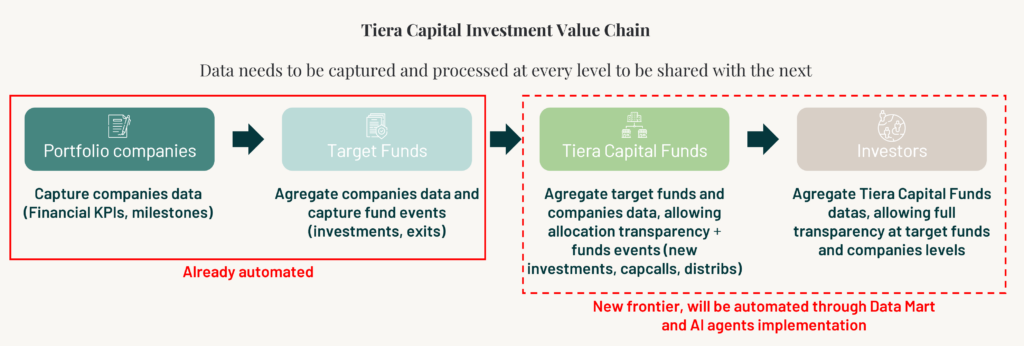
Source: Tiera Capital.
This is where Tiera Capital identified an early strategic inflection point.
Around 2019, the firm began repositioning the traditional fund-of-funds model into a scalable data intelligence platform. What had historically been viewed primarily as an investment aggregation business became increasingly centred around data extraction, structuring and analysis capabilities.
This transformation required a multi-million-euro technological investment. Tiera Capital built uses artificial intelligence (AI)-enabled extraction processes capable of converting unstructured GP reporting into structured and usable portfolio intelligence.
Partnerships with specialised start-ups accelerated the build-out of a modern data architecture capable of consolidating information across more than 300 monitored funds.
Asset-level data capture improved portfolio monitoring capabilities and strengthened benchmarking analysis across managers, sectors and vintages. AI-supported portfolio monitoring enhanced risk oversight and improved the quality of evidence-based client communications. Internally, implementing a private equity-native CRM and a centralised data infrastructure created a single source of truth, reducing reliance on fragmented, Excel-based workflows that had previously constrained scalability and consistency.
Yet even with significant advances in data aggregation and monitoring, one major bottleneck remained unresolved: last-mile transparency.
Producing tailored investor reporting often continued to require substantial manual intervention. Customising portfolio analysis, synthesising qualitative insights and adapting outputs to different investor needs remained difficult to scale efficiently. As private markets themselves became more complex, reporting complexity expanded alongside them. That is where the next battle is being fought.
The future of private markets transparency will not simply depend on collecting more data. It will also have to focus on building unified portfolio backbones capable of creating scalable investor intelligence.
Tiera Capital’s continued investment in Data Mart infrastructure has helped centralise portfolio data into a unified architecture. AI systems can increasingly automate reporting generation, produce near-real-time deliverables and synthesise investment insights at scale.
This extends beyond quantitative analysis alone. AI is also beginning to support scalable qualitative interpretation, including ESG narrative generation, portfolio commentary drafting and thematic analysis across large datasets that would historically require extensive manual review. Transparency itself is becoming part of the product offering.
Managers capable of delivering on-demand portfolio intelligence, curated insights and disciplined signal-versus-noise analysis gain a growing distribution advantage in an increasingly competitive fundraising environment. Investors have now started evaluating the quality, accessibility and usability of the information surrounding those investments. This explains why data infrastructure has become a clearly defined competitive moat.
Scale matters because it improves the quality of data capture, benchmarking and AI training capabilities. Better data infrastructure strengthens investment discipline, enhances conviction and improves long-term decision-making across portfolios. Private markets will always remain complex. However, it is increasingly important to ensure this complexity does not create an opaque environment for investors. Complexity no longer goes hand in hand with opacity.


12, rue Eugène Ruppert
L-2453 Luxembourg
© ALL RIGHTS RESERVED 2026, INDOSUEZ FUND SOLUTIONS